AI was coming to editorial workflows. The design principles weren't ready.
ArcXP is the software division of the Washington Post, formally founded in 2015 after the Post's internal CMS started attracting interest from other media companies. Today, ArcXP serves media companies, publishers, and enterprise customers across real estate, sports and entertainment, and finance — a platform used daily by journalists and editors at some of the most trusted news brands in the world.
As AI began reshaping what's possible in editorial workflows, those organizations started paying close attention. The promise was real: AI could handle rote writing tasks — headline generation, tagging, text-to-speech — buying journalists time to focus on the work that requires human judgment. But the tension was equally real. Ceding control to AI in a newsroom context raises serious questions about editorial ethics, content provenance, and the risk of obscuring what a human wrote versus what a machine suggested. These companies also take their ethical obligations to readers seriously when it comes to disclosing AI-generated content.
"Many editorial companies see AI as a double-edged sword: yes, AI can improve editorial workflows and buy journalists precious time. At the same time, ceding control to AI seems scary and potentially a slippery slope."
How do we fold AI into a product used by journalists — people who take their ethical obligations around content provenance extremely seriously — without eroding the trust that makes these tools worth using at all?
Design team as framework builders
Before we could design for AI features, we needed to establish what we believed about AI. Our design team ran a series of open-ended workshops — candid conversations to surface our own perspectives on where AI should and shouldn't inform user decisions and interactions.
From there, we started reflecting on the ethics of AI and how we wanted ArcXP to embody those ethics in the product. The resulting design guidelines went through several rounds of revision, including dedicated feedback sessions with Engineering and the front-end collective at ArcXP, and a review with ArcXP Labs — the dedicated R&D division tasked with all AI exploration and research for the product.
This work was started but not finalized during my tenure at ArcXP. What follows is genuine, directional thinking — and a real starting point for responsible AI design in a high-stakes editorial context.
From workshops to principles to use cases
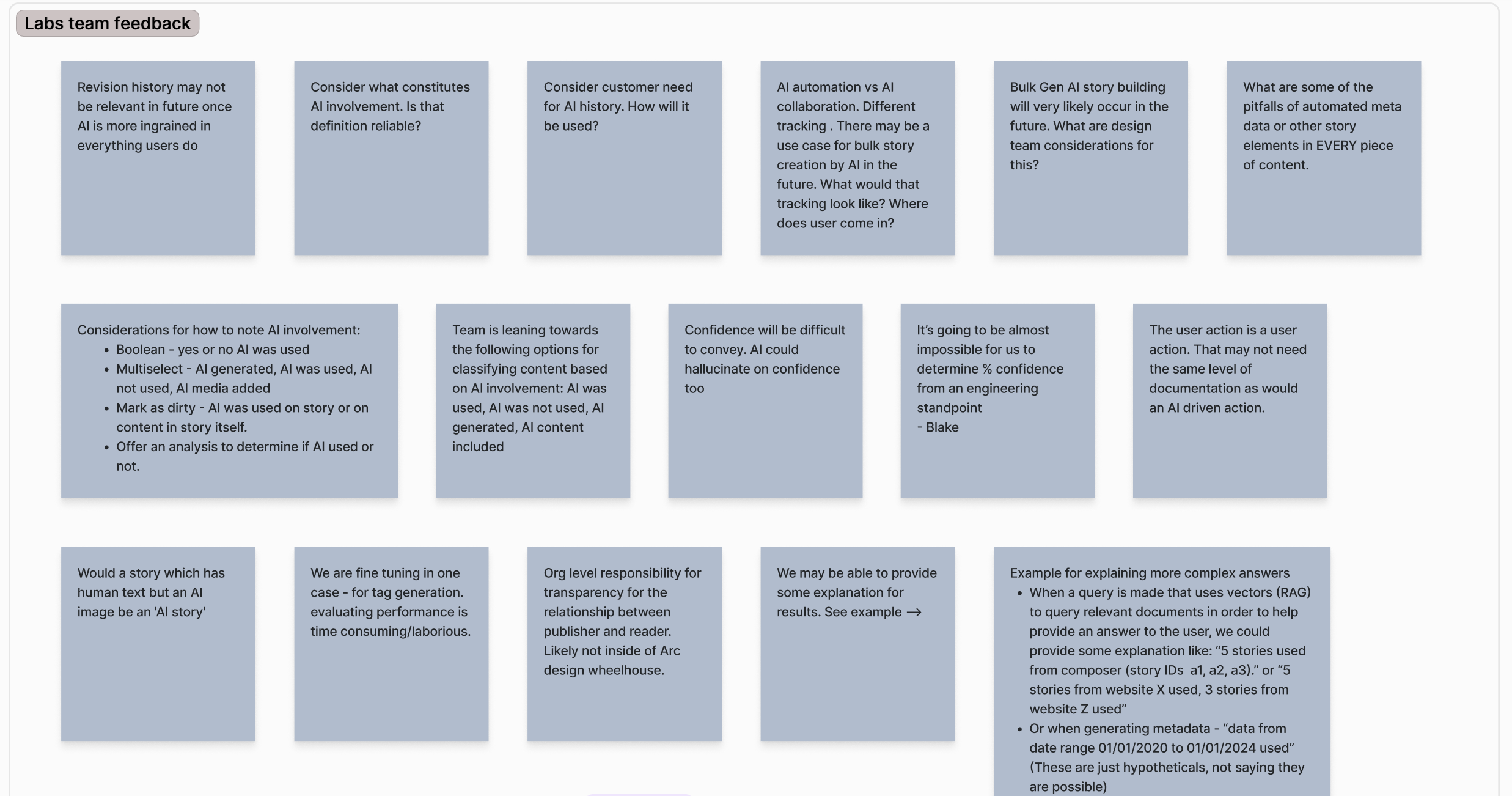
Four principles for designing with AI responsibly
Build Trust Through Transparency. Creating effective AI tools builds trust — but only with transparency. We asked: where, when, and how should users be informed of AI involvement? Is there a risk that bias from the dataset could impact the output? We committed to surfacing this information by default, not on demand — and to giving users a historical trail of AI interaction when the task warranted it.
Empower the Human User. Supporting the human user remained our primary goal. AI output should always be reviewable and approachable. When results are complex or sensitive, we committed to providing more explainability — higher sensitivity means higher need for context. AI should fit seamlessly into existing workflows, not interrupt them.
Design for Uncertainty. AI output can be unpredictable, with real risks: hallucinations, toxic language, copyright issues. This required closer collaboration with engineering than typical UX work — designing two-way communication so users can refine their input and improve output quality. Even simple feedback mechanisms (a thumbs up / thumbs down) became part of the design spec.
Use AI Intentionally. With the excitement around AI, it's easy to default to it as the answer. We committed to evaluating AI against non-AI solutions for every use case — understanding the benefits and potential risks before moving forward. The question wasn't "can we use AI here?" It was "should we?" We documented specific cases where AI makes sense (repeatable, rote tasks; tedious work with low editorial stakes) and where it doesn't (sensitive or destructive actions; situations where accuracy is paramount).
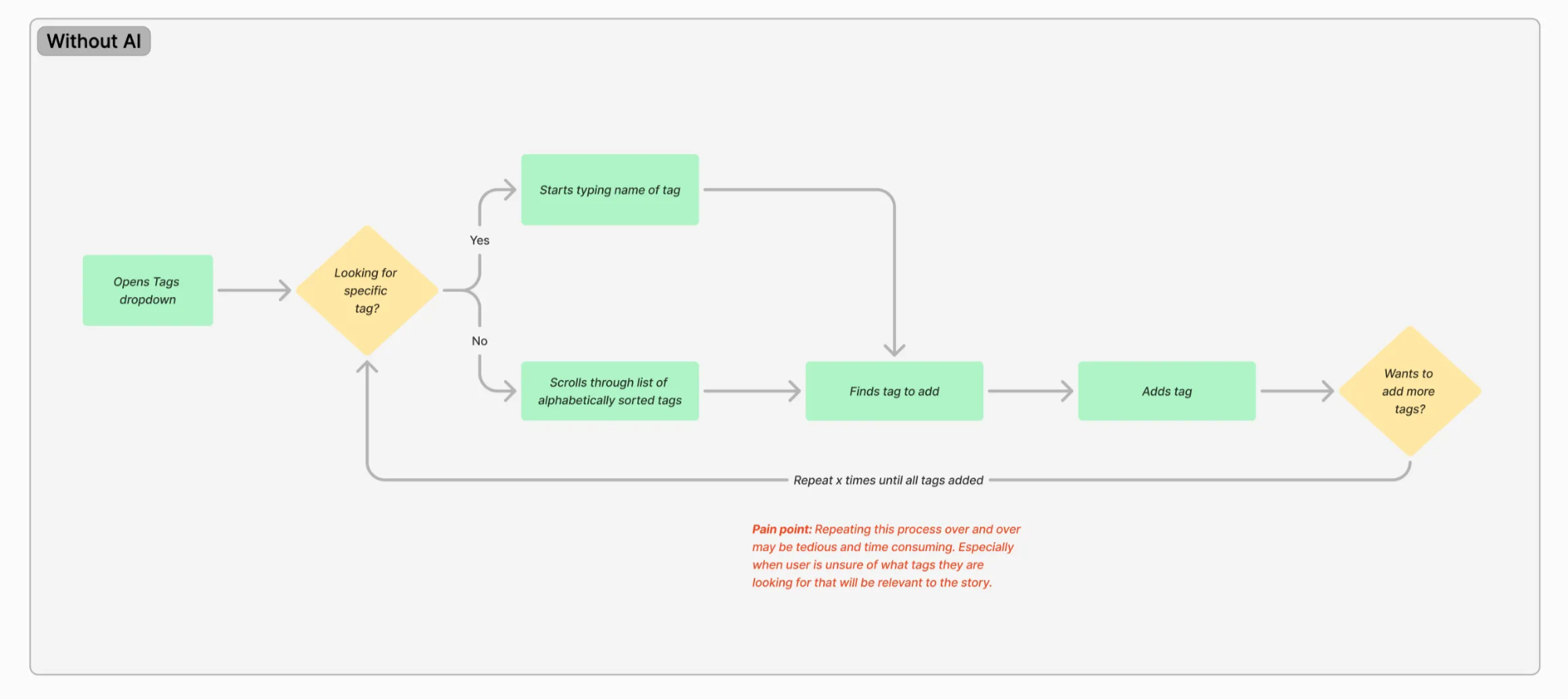
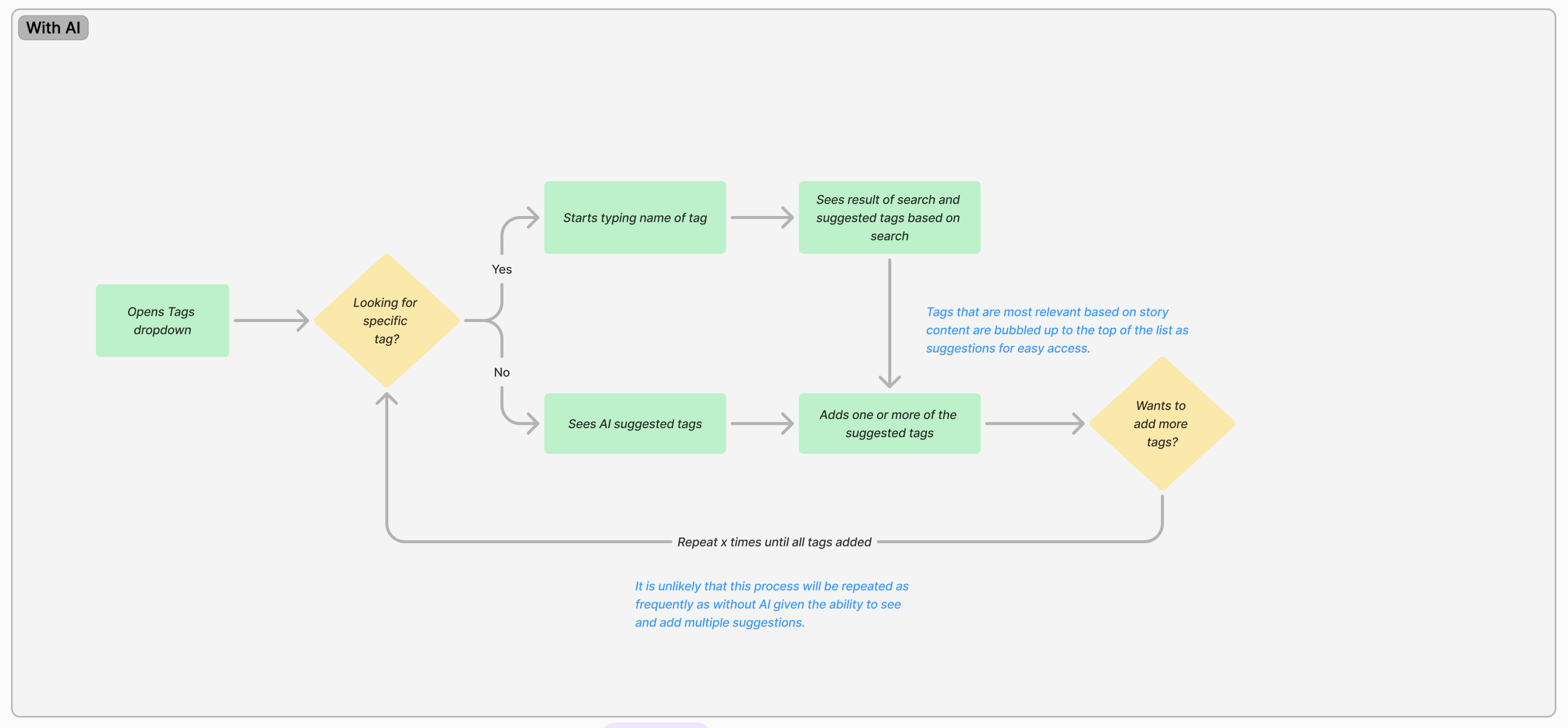
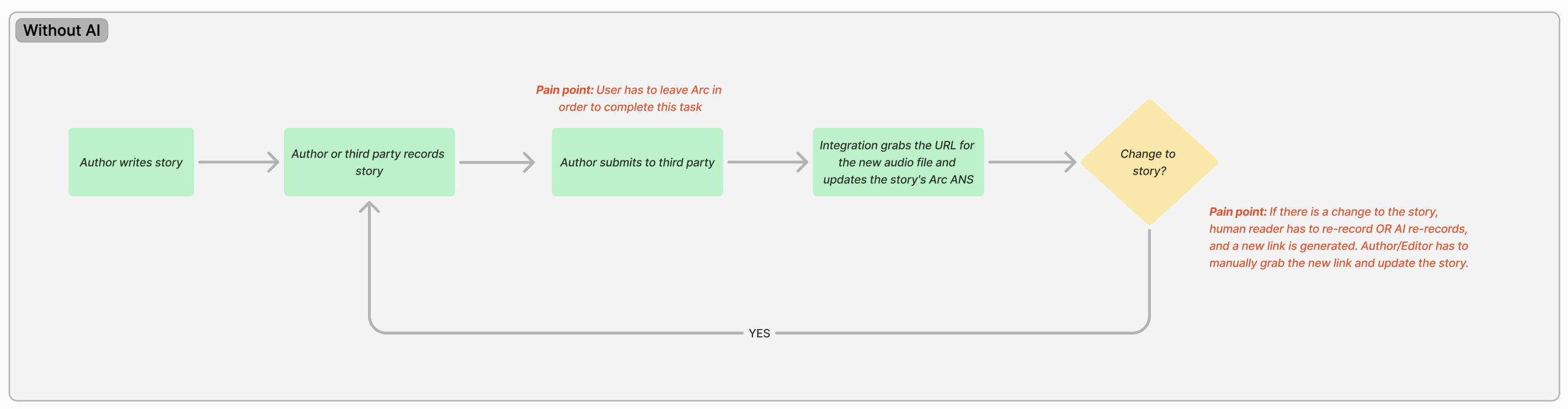
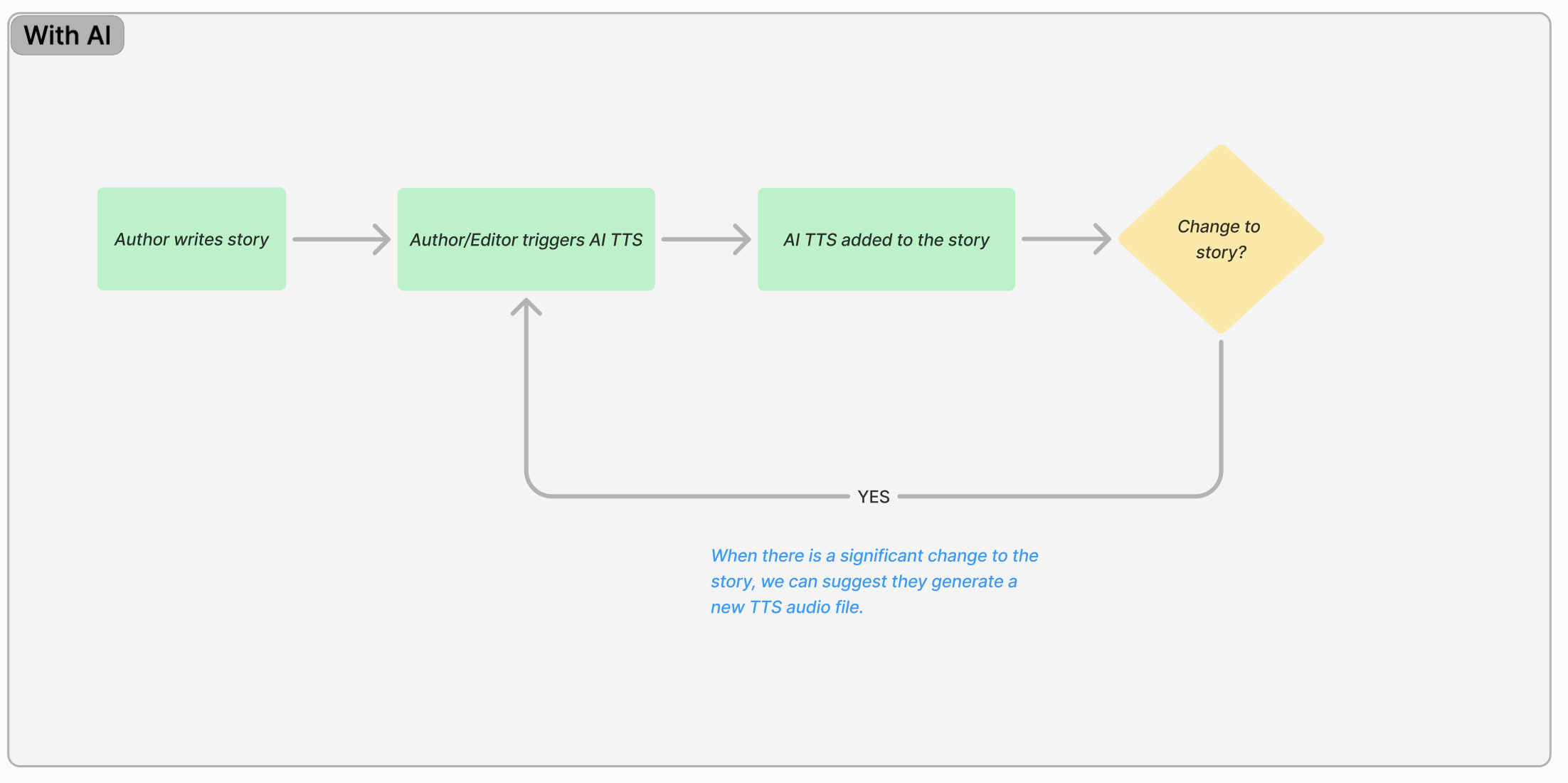
We applied these principles directly to two feature use cases. The Tagging use case is shown in the Before & After below. In the Text to Speech case, the guidelines surfaced clear customer value: smaller and midsize publishers — particularly LATAM customers — were less likely to invest in human-read audio. AI text-to-speech gave them flexibility, including support for multiple Spanish accents, with users in control of choosing between author-read and AI-generated audio.
Applying the framework: Tagging
Applying the framework: Text to Speech
Where the work landed
This work was foundational, not shipped — and that distinction matters. The value here isn't a metric; it's that the design team established a principled position on AI before features started shipping. Engineering and ArcXP Labs engaged seriously with the framework. The validated next step would have been prototyping and testing with at least 10 clients from the internal customer panel, followed by iteration and a more formal rollout via A/B testing and Pendo.