I don't just design
for AI — I design with it.
Over the past year I've moved from using AI as a novelty to integrating it as genuine infrastructure in how I work. Here's what that actually looks like — and what it changes.
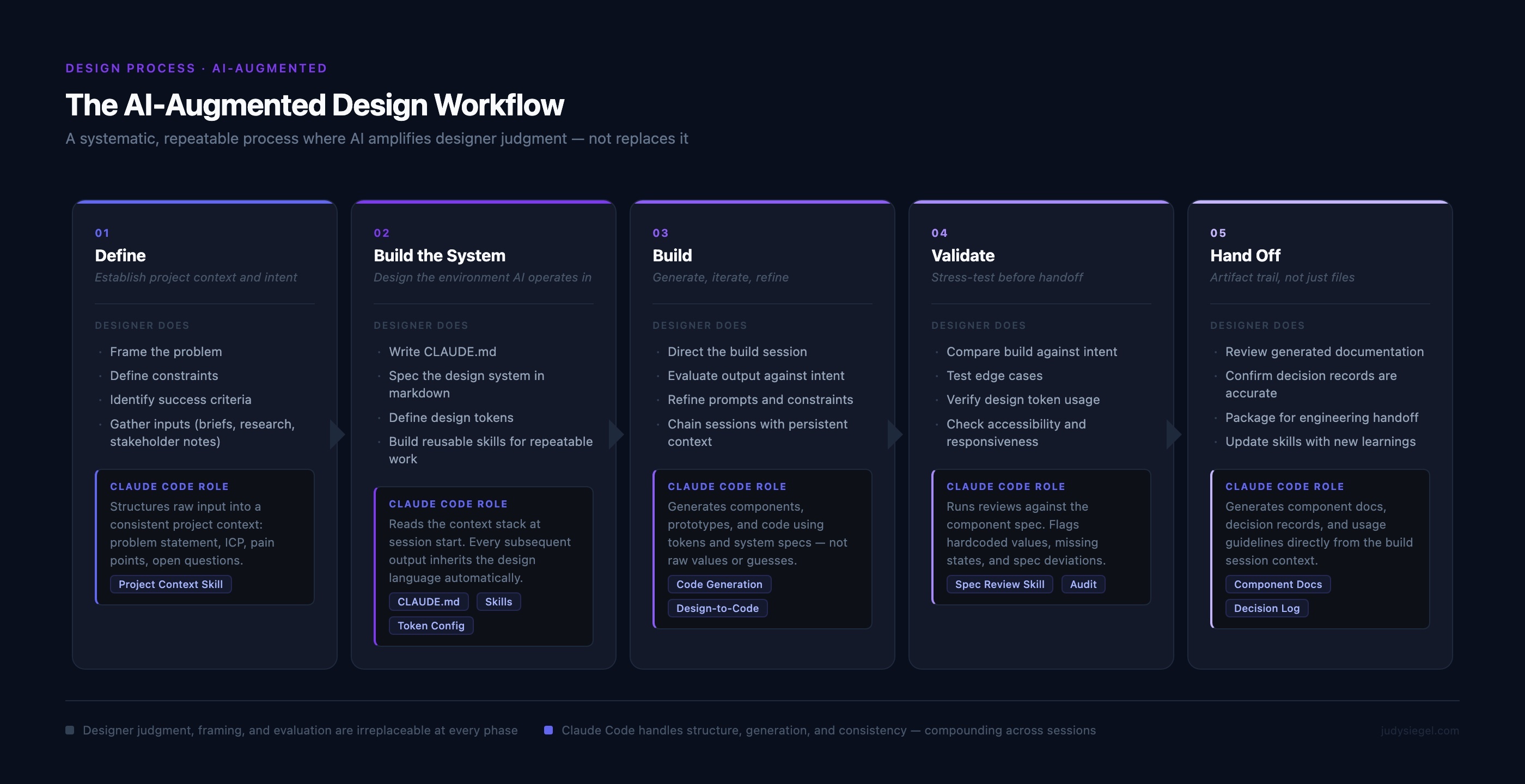
Context is the real work now.
The insight that changed how I think about AI in design: the quality of AI output is entirely determined by the quality of context you give it. Vague briefs, vague results. Precise context, precise results.
That means the designer's job has expanded — not shrunk. I'm not just designing interfaces. I'm designing the environment the AI operates in: the CLAUDE.md files, the component specs, the token systems. That's the new leverage point.
What Working with Claude Code Changes
Four fundamental shifts in how a designer operates with AI as infrastructure
Prompts become Skills
- –Rewrite the brief every session
- –Quality varies by who's typing
- –Starts from scratch each sprint
- —Skills encode the methodology
- —Consistent output, any team member
- —Compounds across sprints
Re-explanation is the signal. If you rebuild context every session, that's the skill you haven't written yet.
Figma specs become executable context
- –Design lives in Figma files
- –Engineers re-interpret visuals
- –Tokens exist only in design tools
- —Spec lives in structured markdown
- —Claude reads and generates from spec
- —Tokens in config → every component inherits
Claude reads text, not Figma. A design system in a markdown file is a brief Claude can act on directly.
Personal output becomes team infrastructure
- –One great prompter, high variance
- –Knowledge walks when they do
- –Can't survive deadline pressure
- —Methodology encoded as portable files
- —Survives turnover and context-switching
- —Quality is structural, not personal
Individual AI competence is a single point of failure. Skills make the org the expert.
Sessions become a compounding system
- –Each session starts cold
- –No artifact trail between sprints
- –Handoff requires manual documentation
- —CLAUDE.md loads full project context
- —Decision records generated from sessions
- —Component docs produced at build time
What Claude knows at session start is what you gave it. The context stack is the system.
Designer judgment, framing, and evaluation are irreplaceable at every phase · Claude Code handles structure, generation, and consistency